2 Bottles
60-day supply · 2 x 30 capsules

$79 / bottle
$158 total
- 2 bottles · 60 capsules
- 60 servings at one capsule a day
- 60-day money-back guarantee
- $9.99 shipping
Official U.S. Sodatide shop. Help with an existing order: the order desk in the footer.
Official product information
SodaTide is a once-a-day synbiotic capsule for digestive and metabolic support. Each capsule pairs two prebiotic fibres, 211 mg chicory root inulin and 100 mg potato resistant starch, with a 36 mg probiotic blend of Bifidobacterium infantis, Clostridium butyricum and Akkermansia muciniphila. Take one capsule a day with an 8 oz glass of water, ideally in the morning before a meal, and keep the open bottle in the fridge. It is made for healthy adults 18 and over. Each bottle holds 30 capsules, a 30-day supply, and every pack comes with a 60-day money-back guarantee through the official checkout.
The short answer
Sodatide is a once-a-day dietary supplement capsule for digestive and metabolic balance.
Use case: Adults who want a simple fibre and probiotic routine take one capsule a day with an 8 oz glass of water.
How it works: Chicory root inulin and potato resistant starch are fibres that gut bacteria ferment, and a 36 mg blend adds B. infantis, C. butyricum and A. muciniphila.
Label read again on September 30, 2026 · every line of the Supplement Facts panel


30 capsulesOne a day, 30 days
3 species named36 mg blend, no CFU count
60 daysMoney-back window
Label read on September 30, 2026 · every printed lineThe Sodatide bottle prints Advanced Metabolic Science, Metabolic and Digestive Support, 30 capsules and a 30-day supply. The panel lists 211 mg chicory root inulin, 100 mg potato resistant starch and a 36 mg probiotic blend.
This page establishes three named ingredients with every amount printed: 211 mg, 100 mg and a 36 mg blend per capsule. No CFU count is published. The facts come from five opened sources, and no star rating is shown.
Chicory root inulin, potato resistant starch and a probiotic blend.
211 mg, 100 mg and a 36 mg blend in each capsule. No CFU count, which we mark as not published.
NIH, NCCIH and FDA pages, read on the date at the foot of every page.
The review material supplied is marked layout copy, so this site shows none.
At a glance
The Sodatide bottle holds 30 capsules, taken at 1 capsule a day, with 3 named ingredients. The panel adds up to 347 mg of actives per capsule. It names the probiotics by genus and species but prints no CFU count.
The fourth number adds up the panel: 211 mg of inulin, 100 mg of resistant starch and a 36 mg probiotic blend. A probiotic is identified by genus, species and strain and measured in colony-forming units; this label prints the first two for each organism and not the last two. The label, line by line.
Probiotic identity
The Sodatide probiotic blend is named to genus and species: Bifidobacterium infantis, Clostridium butyricum and Akkermansia muciniphila. The label prints no strain code and no CFU count, so trial results can be matched to the species only in general.
Research tests a strain at a measured dose. To carry a result across to a bottle you need four things, and this label prints two of them for each organism: the genus and the species. The strain code and the CFU count are the blanks.
| Identity level | What research names | What this label prints |
|---|---|---|
| Genus | Lactobacillus, Bifidobacterium, Saccharomyces | Bifidobacterium, Clostridium, Akkermansia |
| Species | L. rhamnosus, B. longum, and so on | B. infantis, C. butyricum, A. muciniphila |
| Strain | the code after the species - what a trial tests | not published |
| CFU count | colony-forming units per serving - the amount | not published |
NCCIH puts it plainly: if a specific kind of Lactobacillus helps prevent an illness, that does not necessarily mean that another kind of Lactobacillus, or any of the Bifidobacterium probiotics, would do the same thing. A finding belongs to an organism, not to the word “probiotic”.
NIH defines probiotics as live microorganisms that provide health benefits when they are taken in sufficient amounts, and notes that a CFU count can fall between manufacture and use. The label weighs the blend at 36 mg but gives no count, so there is no way to say whether the live amount is sufficient.
The label says to refrigerate for optimal quality, and the brand’s directions add that the bottle should be refrigerated after opening to protect the probiotics. Both agree that potency matters, on a bottle that prints no potency figure. The fridge instruction in full.
$49 a bottle on the six-bottle pack, $69 on three, $79 on two · 60-day money-back guarantee on every pack
See pack pricesThe product
SodaTide is a dietary supplement capsule that combines prebiotic fibre with three probiotic species, a type of product called a synbiotic, for metabolic and digestive support. A bottle holds 30 capsules at 1 capsule a day, so it lasts 30 days. The distributor printed on the label is Instituto Experience of Lakeland.
A capsule sold as a metabolic and digestive supplement, 30 to a bottle at 1 capsule a day, which makes a bottle 30 days. The front carries six lines and three small icons; the side panels carry the directions, the caution, the Supplement Facts and the distributor, Instituto Experience of Lakeland, Florida. The factory itself is not named.
The directions are 1 capsule daily with an 8 oz. glass of water. The brand’s own advice is a morning dose, ideally before a meal. The one instruction worth reading twice is the storage advice: the label says to refrigerate for optimal quality, and the brand adds that an open bottle belongs in the fridge to protect the probiotics.
A dietary supplement is not a medicine. These statements have not been evaluated by the Food and Drug Administration. This product is not intended to diagnose, treat, cure, or prevent any disease.

The three
Two of the three Sodatide ingredients are fibres, chicory root inulin and potato resistant starch, with a category statement behind them. The third is a probiotic blend of three named species that is weighed but not counted.
Two of the three are fibres with a category statement behind them. The third is a blend of three named species, weighed but not counted.
Chicory Root Inulin
A soluble fibre extracted from chicory root
A category statement, no product findingWhat the label prints for it: 211 mg per capsule, listed as Cichorium intybus root. No standardisation or source beyond that.
FDA's dietary fibre definition covers non-digestible carbohydrates that FDA has determined to have physiological effects beneficial to human health, and its published examples of such effects are lowering postprandial blood glucose or insulin, lowering fasting LDL-cholesterol or fasting blood glucose, lowering blood pressure, improved laxation, increased mineral absorption and reduced energy intake. FDA has said it intends to propose adding inulin and inulin-type fructans to that definition. That is a statement about a category of fibre, not a finding about this product, and none of the sources we opened reports a weight-loss result for inulin.
Potato Resistant Starch
A starch that resists digestion in the small intestine
A category statement, no product findingWhat the label prints for it: 100 mg per capsule, listed as potato resistant starch from the tuber.
FDA has also said it intends to propose adding high amylose starch, which is resistant starch type 2, to the dietary fibre definition. NIH's fact sheet on dietary supplements for weight loss is blunt about the wider category: there is little scientific evidence that weight-loss supplements work. It discusses two other fibres by name and finds glucomannan has little to no effect on weight loss and that guar gum probably does not help you lose weight. It does not cover resistant starch, so we do not extend those findings to it.
Probiotic Blend
Three live species, named without strain codes
Named to species, not strainWhat the label prints for it: 36 mg for the blend, naming Bifidobacterium infantis, Clostridium butyricum and Akkermansia muciniphila. No strain codes, no split between them and no CFU count.
This is the ingredient the product is built around, and the hardest to check. NIH defines probiotics as live microorganisms that provide health benefits when they are taken in sufficient amounts, and NCCIH is explicit that the effects do not transfer between organisms: if a specific kind of Lactobacillus helps prevent an illness, that does not necessarily mean that another kind of Lactobacillus or any of the Bifidobacterium probiotics would do the same thing. This label names the three species but no strain codes and no CFU count, so research on a particular strain cannot be applied to it directly. On weight specifically, NIH says some studies have shown that probiotics might slightly reduce body weight or body fat, and that other studies have shown that probiotics have no effect or might even increase body weight.
Every line on these panels is traceable to the five references at the foot of the ingredients page. Where a source does not cover something, this site says so instead of reaching for material it has not read.
The label
The front of the Sodatide bottle prints six points, from Advanced Metabolic Science down to the 30-day supply line. Select a number on the bottle, or use the arrow keys, to read what each point means.
Six points on the front of the bottle. The side panels, with the Supplement Facts, are typed out in full on the label page.
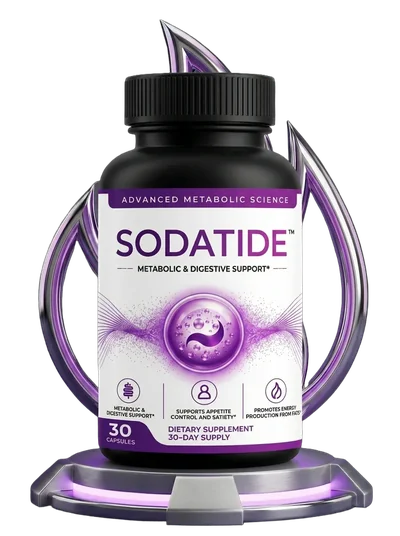
Select a number on the bottle, or use the arrow keys.
A line of marketing type above the wordmark. It is not a claim about the contents and it carries no amount.
Sodatide, with a trademark mark. This is the brand, not a description of what is inside.
The descriptor, and the asterisk that carries the FDA statement at the foot of every page on this site.
The three support lines, set beside small symbols. They are claims about what the product is sold to support, not findings.
The only numbers on the front; the amounts are on the Supplement Facts panel at the side.
The statutory category line. The Supplement Facts panel, the directions and the caution sit on the side panels.
Serving size 1 capsule, 30 servings per container. Chicory root inulin (Cichorium intybus, root) 211 mg; potato resistant starch (tuber) 100 mg; probiotic blend 36 mg, listing Bifidobacterium infantis, Clostridium butyricum and Akkermansia muciniphila. A dagger marks each amount because no Daily Value has been set.
Other ingredients: hypromellose (vegetarian capsule), microcrystalline cellulose, magnesium stearate and silica. What the panel leaves out is the CFU count and the split of the 36 mg between the three species.
Lot SOD-26/SO-3431 and CoA SOD-3431-26-SO came with this stock. The lot and certificate references supplied with this stock are draft label values, not laboratory proof. No certificate of analysis document has reached this desk, and a reference string is not a document. What a certificate would have to contain.
How it is meant to work
Sodatide is a synbiotic: the fibres are prebiotics and the three species are probiotics. The label says only to take one capsule daily with a glass of water, in the morning before a meal, and to refrigerate the bottle after opening.
Four definitions and one limit. Scroll the steps and the panel beside them keeps pace.

The words prebiotic, probiotic and synbiotic have settled definitions, and this product uses all three. The steps below take them one at a time in the order the capsule is meant to work, and then arrive at the step where checking gets harder.
None of the five sources we opened tested this finished formula. They describe the categories, which is a different thing.
The FDA dietary fibre definition covers non-digestible carbohydrates it has determined to have beneficial physiological effects, and FDA has said it intends to propose adding inulin and high amylose starch to that definition.
Sufficient amounts is a quantity. On a probiotic label that quantity is normally a CFU count. This one prints a weight, 36 mg, and no count.
The idea is coherent. Whether this particular combination does anything is a separate question, and the label does not give you what you would need to ask it.
The species are named, so the general research on each can be read. What cannot be matched is the strain a given trial used.
Read what the label prints, and treat the two blanks, strain and count, as blanks.
NCCIH defines prebiotics as nondigestible food components that selectively stimulate the growth or activity of desirable microorganisms. Chicory root inulin and potato resistant starch are both in that family. NCCIH on probiotics.
NIH defines probiotics as live microorganisms, such as bacteria and yeasts, that provide health benefits when they are taken in sufficient amounts. The words that do the work in that sentence are live and sufficient amounts. NIH on probiotics.
NCCIH: synbiotics are products that combine probiotics and prebiotics. In form, that is what this bottle is — two fibres and a live culture in one capsule. That is a description of the category, not a finding about the product.
To check a probiotic claim you match the organism in the bottle to the organism in the study. NCCIH is explicit that the match has to be exact: a different kind of Lactobacillus, or a Bifidobacterium instead, is a different question. This label names three species but no strain codes, so the match can be made to the species and no further.
The serving, the three amounts, the capsule count, the price, the guarantee window and the storage advice are all printed and all verifiable. This site publishes those and marks the strain codes and the CFU count as not published. The mechanism page in full.
Step 1 of 5
Safety
NIH records that in healthy people probiotics may cause gas but rarely cause infections or other health problems. People who are seriously ill or have weak immune systems face a higher risk and should ask a doctor first.
NIH: “In healthy people, probiotics may cause gas, but they rarely cause infections or other health problems.” That is the reassuring half of the record, and it is about healthy people taking identified probiotics. The NIH fact sheet.
NIH also records that probiotics “might also cause problems such as bacterial infections in people who are already seriously ill or who have weak immune systems”, and NCCIH notes that cases of severe or fatal infections have been reported in premature infants given probiotics. If either description fits you, this is a conversation for a clinician.
Healthy adults aged 18 or older only. Not for anyone under 18. Anyone taking medicine should speak to a doctor before use. Stay at the label dose unless a clinician advises otherwise.
Safety findings are as strain-specific as benefit findings. With the species named but not the strains, both lines apply to these organisms in general rather than to the exact strains in the bottle. The cautions in full.
How to take it
Take 1 capsule a day with an 8 oz glass of water. The brand suggests a morning dose, ideally before a meal. Once the bottle is open, keep it refrigerated to protect the probiotics. A bottle of 30 capsules lasts 30 days.
The directions are 1 capsule daily with an 8 oz. glass of water. The brand’s own advice is a morning dose, ideally before a meal.
That is the label’s own suggestion rather than a rule, and it is the kind of instruction that is easier to keep than to remember.
The brand asks for the fridge once the bottle is open, and the label says to refrigerate for optimal quality. No temperature is given.
30 capsules at one a day is 30 days. Two bottles is 60 days, which is exactly the guarantee window. Three is 90 and six is 180, both of which run past it.
Who it is for
Sodatide is for healthy adults 18 and over. Answer five short questions to see which of three readings applies to you. Nothing is sent anywhere and nothing is stored.
Healthy adults 18 and over. Answer all five and this shows you which of three readings applies. Nothing is sent anywhere and nothing is stored.
These come from the label's own caution text and from what NIH records about who is at greater risk.
Are you under 18?
Do you take any prescription or over-the-counter medicine?
Are you seriously ill, or does a condition or treatment weaken your immune system?
Are you expecting this to change your weight on its own?
Would you want to know which strains are in it before you took it?
You answered yes to something the label itself flags, or to the group NIH specifically names as being at greater risk from probiotics. That conversation is worth having before a purchase rather than after one.
Two or more of your answers point at questions this label cannot answer. NIH says it is unclear whether probiotic supplements have any effect on weight or body fat, and the bottle names its probiotic species but not the strains.
Your answers do not hit any of the label’s own cautions. One open question remains: the label names three species but no strain codes and no CFU count, so trial results can be matched to the species only.
This is a reading aid, not medical advice. It cannot know your history and it is not a substitute for asking a clinician.

Before you order
Check with a doctor before the first capsule if you are pregnant, nursing, under 18, have a known medical condition or take any medicine. The label asks these groups to consult a physician before this or any supplement.
Six questions. A yes to any of the first four means the label goes to your doctor before the first capsule.
Some gas or bloating in the first weeks is common with added fibre (NIDDK).
Pricing
Two bottles cost $79 each plus $9.99 shipping. Three bottles are $69 each and six are $49 each, with free US shipping from three bottles. Every pack carries the same 60-day money-back guarantee.
Two bottles is $79 each, plus $9.99 shipping. Three brings it to $69 a bottle and six to $49. Every pack carries the same 60-day money-back guarantee, so the window is identical whichever you pick.
60-day supply · 2 x 30 capsules
$158 total
FREE SHIPPING
90-day supply · 3 x 30 capsules

$207 total
MOST POPULAR
180-day supply · 6 x 30 capsules

$294 total
Prices are charged in US dollars on the Sodatide order page and are confirmed at checkout before you pay. Free US shipping starts at three bottles. One capsule a day makes a bottle 30 days, so six bottles is 180 days of product against a 60-day window: see cost per day.
Cost per day
At one capsule a day, two bottles last 60 days and cost $2.63 a day, three bottles last 90 days at $2.30 a day, and six bottles last 180 days at $1.63 a day. The 60-day window is shorter than the 90 and 180-day packs.
| Pack | Days of product | Total | Cost per day | Inside the window |
|---|---|---|---|---|
| 2 Bottles | 60 days | $158 | $2.63 | 60 of 60 days |
| 3 Bottles | 90 days | $207 | $2.30 | 60 of 90 days |
| 6 Bottles | 180 days | $294 | $1.63 | 60 of 180 days |
The last column is the part most price tables leave out. Two bottles is 60 days against a 60-day window, which lines up exactly. Three and six do not. The full price breakdown.
The guarantee runs 60 days from purchase. A pack that lasts longer than that means the last stretch of it is outside the window when you finish it. That is worth knowing before you buy six rather than after.
The guides
Five bonus guides were supplied as covers only: 10-Day Metabolic Challenge, Accelerated Metabolism, Renova Flora Protocol, Facial Rejuvenation and Sleep Live Better. Their contents are not published, so we cannot say what they contain.

Contents not published

Contents not published

Contents not published

Contents not published

Contents not published
Cover 1 of 5
Cover artwork for five guides was supplied with this stock. What is inside them, which packs include them and how they are delivered are all not published, so this site shows the covers and says that rather than describing contents it has not seen. Ask the order desk before you buy if a bonus is the reason you are buying.
Reviews
No verified review data was supplied for Sodatide. The score, review count, order count and eight named customers in the stock pack are marked as layout copy, which means placeholders. This site shows no star rating and no testimonials.
What was supplied
No verified review data has been supplied for this product. The score, the written count, the order count and the eight named customers that came with the stock pack are marked in that pack as layout copy, which means they are placeholders rather than people. We will not publish placeholder testimonials as though they were customers, and we do not publish a star rating we cannot stand behind. If the seller supplies a real review export we will publish it here and say where it came from.
Which platform collected them, and whether it is the seller’s own software or an independent service with an operator to ask.
Every review tied to an order the desk can confirm exists, not a verified-buyer badge, which is only an assertion.
Every rating with a count at each level. A set that arrives without its lowest ratings was filtered.
How many orders they were drawn from, and over what period. An average with no denominator means nothing.
How reviewers were approached and whether anyone chose who was asked. How a set was gathered decides what it shows.
Item 1 of 5
Those are five of the nine things this site would check. If the seller supplies a real export that meets them we will publish it and say where it came from. The reviews page, in full.
The guarantee
The window runs 60 days from purchase, or longer if the sales page prints a longer one. It is a buying policy, not a medical promise. Refunds, tracking and order changes go to the order desk.
The window runs 60 days from purchase, or longer if the sales page prints a longer one. It is a buying policy and no medical promise.
Refunds, tracking and order changes go to the order desk on the order desk (number in the footer). Its opening hours are not published, so this site cannot tell you when to call. The website address here cannot see orders, so a refund request sent there will only be forwarded.
The buyer pays return shipping, and the seller asks you to use tracking. Include your full name, the email on the order and the order ID. 3 to 5 business days after the desk credits the order, then a further 5 to 10 days for the card to post it. Returns go to 390 Park Avenue, Floor 3, New York, NY 10022, USA, which is a different address from the office.
It is a seller promise honoured by the seller. It is not insurance, it is not a third-party certification, and it says nothing about whether the product works. A money-back window and evidence are separate questions, and this site keeps them separate.
Our verdict
The score has eight rows of ten points each, with the reason printed beside every row. Label transparency scores 7 out of 10 because the panel is full and every ingredient has an amount. Each row is a judgement.
Eight rows, ten points each, with the reason printed beside every one. Nothing here is an average of anything; each row is a judgement we are willing to defend.
7/10
A full Supplement Facts panel with an amount for each of the three ingredients and an other-ingredients line. Points go for the CFU count and the per-species split, neither of which is printed.
5/10
The two fibres are named precisely enough to look up, and the blend names three species. There are no strain codes and no CFU count, which is where the other five points go.
3/10
FDA's fibre definition is a category statement about inulin and resistant starch, not a finding about this product, and NIH says it is unclear whether probiotic supplements affect weight or body fat.
3/10
Every amount is printed, and each is small next to research doses: 311 mg of fibre against the grams used in trials, and a 36 mg blend with no count to set against NIH’s “sufficient amounts”.
4/10
Lot SOD-26/SO-3431 and CoA SOD-3431-26-SO are draft label references rather than laboratory proof. The label names a distributor, Instituto Experience of Lakeland, Florida, but no factory and no best-before date.
7/10
One capsule a day with water is about as simple as it gets. The refrigeration instruction is the one real demand, and it comes with no temperature and no guidance on unopened bottles.
5/10
The label asks pregnant or nursing mothers, children under 18 and anyone with a known medical condition to consult a physician. It says nothing specific about the weakened-immune group NIH flags as being at greater risk.
6/10
A 60-day window on every pack, free US shipping from three bottles, and prices confirmed before payment. The order desk publishes no opening hours.
40out of 80
A simple capsule with a complete label and small doses. The panel prints every amount and names the three probiotic species; points go for the missing strain codes and CFU count, and for doses well below the amounts used in research. What we found for the fibres is a category statement from FDA rather than a result, and that is as far as the printed evidence goes.
Further reading
Six pages follow on from this one, including Probiotics explained, a post on genus, species and strain, a post on what a CFU count is and a post on inulin. Every page is linked in the list below.
How this page was written
Every fact was read off the label images and the seller's pack, then checked against five public sources opened on September 30, 2026. Where the label is silent we write not published. We are the official U.S. Sodatide shop.
Every fact on this page was read off the label images and the supplier pack, then checked against five public sources that we opened on September 30, 2026. Where the label is silent we write not published and list the gap beside this rather than estimating.
We are the Official U.S. Sodatide shop. We earn a commission when you buy through the links here, which does not change your price and does not change what the label says.
Questions
These answers cover the Sodatide ingredients, the capsule form, how to take it, side effects, price, reviews, FDA status and who should check with a doctor first. Type a word in the box to filter the questions.
Sodatide is a dietary supplement capsule for digestive and metabolic balance, sold as 30 capsules to a bottle at 1 capsule a day. Each capsule holds 211 mg chicory root inulin, 100 mg potato resistant starch and a 36 mg probiotic blend. This is the official U.S. Sodatide shop.
SodaTide is a real dietary supplement with a printed label. The label names each ingredient with its amount and names the distributor, Instituto Experience of Lakeland, Florida. Orders go through the official checkout linked on this page, and every pack carries a 60-day money-back guarantee.
Sodatide ingredients are chicory root inulin 211 mg, potato resistant starch 100 mg and a 36 mg probiotic blend, in a hypromellose vegetarian capsule with microcrystalline cellulose, magnesium stearate and silica. No allergen statement is printed. What each one is.
The label lists three: Bifidobacterium infantis, Clostridium butyricum and Akkermansia muciniphila, 36 mg in total. It gives no strain codes and no CFU count, and NCCIH is explicit that effects differ between probiotic strains. The label in detail.
The directions are 1 capsule daily with an 8 oz. glass of water. The brand's own advice is a morning dose, ideally before a meal. Once it is open, the brand says, keep it refrigerated to protect the probiotics. 30 capsules is 30 days at that rate. How to take it.
The label does not claim weight loss; it prints metabolic and digestive support. NIH says there is little scientific evidence that weight-loss supplements work, and that it is unclear whether probiotic supplements have any effect on weight or body fat. The NIH fact sheet.
NIH records that in healthy people probiotics may cause gas but rarely cause infections or other health problems. People who are seriously ill or have weak immune systems face a higher risk and should ask a doctor first. Anyone on medication should speak to a doctor before use. The cautions in full.
The label names pregnant or nursing mothers, children under 18 and anyone with a known medical condition. NIH adds people who are seriously ill or whose immune system is weakened, because live bacteria can cause infections in that group. Anyone on medication should also ask first.
No. As a dietary supplement, Sodatide does not go through FDA approval. The FDA-registered facility mark on this page is about the facility, not an approval of the product. Its label claims are about metabolic and digestive support.
$158 for two bottles ($79 each) plus $9.99 shipping, $207 for three ($69 each) and $294 for six ($49 each), with free US shipping from three bottles. Every pack carries the same 60-day money-back guarantee. Cost per day.
Yes. Every Sodatide pack carries the same 60-day money-back guarantee, counted from the purchase date, or longer if the sales page prints a longer window. It is a buying policy, not a medical promise. Refunds go through the order desk listed in the footer.
Because none was supplied that we could verify. The score, review count, order count and eight named customers in the stock pack are marked as layout copy, which means placeholders. We do not publish a star rating we cannot stand behind. The reviews page explains what we would need.
From Sodatidebalance, the official U.S. Sodatide shop, through the checkout linked on this page. Payment is by Visa, Mastercard, Discover, American Express, PayPal or Apple Pay, charged in US dollars. Every pack carries the same 60-day money-back guarantee.
No. Sodatide on this page is a capsule, 30 to a bottle, taken as 1 capsule a day with an 8 oz glass of water. The label does not describe a gummy, a drops or a tablet form.
The Supplement Facts panel lists hypromellose (the vegetarian capsule), microcrystalline cellulose, magnesium stearate and silica as other ingredients. No allergen statement is printed.
Three bottles cost $69 each with free US shipping, and 90 days of product sits against a 60-day window. Two bottles cost $79 each plus $9.99 shipping if you would rather start smaller.
Three bottles is $69 each with free US shipping, and 90 days of product sits against a 60-day window. Two bottles is $79 each, plus $9.99 shipping, if you would rather start smaller.
Add to cart, $207 for 3 bottles
Order desk: listed in the footer · opening hours not published