Formula
Sodatide Ingredients: What Each Capsule Contains
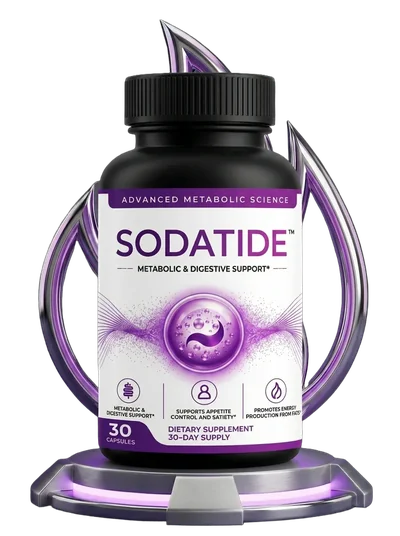
Sodatide has three ingredients: chicory root inulin, potato resistant starch and a probiotic blend.
The panel lists 211 mg, 100 mg and 36 mg. The blend names three species but no strain codes and no CFU count.
See the whole label on the Supplement Facts page.
By the Sodatide Editorial Desk · Medically reviewed by Dr. Meetal Mehta, Physician · Revised
The formula
Three ingredients are named, and each one carries a weight
Two fibres at 211 mg and 100 mg, and a 36 mg blend of three species with no strain codes. Choose a name to see what our sources say and what the label prints beside it.
- A finding in our sources
- A category statement, no product finding
- Studied, no effect found
- The label does not say which strain
Chicory Root Inulin, a soluble fibre extracted from chicory root

A category statement, no product finding
What it is. A soluble fibre extracted from chicory root.
What our sources say. FDA's dietary fibre definition covers non-digestible carbohydrates that FDA has determined to have physiological effects beneficial to human health, and its published examples of such effects are lowering postprandial blood glucose or insulin, lowering fasting LDL-cholesterol or fasting blood glucose, lowering blood pressure, improved laxation, increased mineral absorption and reduced energy intake. FDA has said it intends to propose adding inulin and inulin-type fructans to that definition. That is a statement about a category of fibre, not a finding about this product, and none of the sources we opened reports a weight-loss result for inulin.
What the label prints beside the name. The name. 211 mg on the panel, with no extract ratio and no plant part beyond the word root. The amount of inulin in one capsule is not published.
Potato Resistant Starch, a starch that resists digestion in the small intestine
A category statement, no product finding
What it is. A starch that resists digestion in the small intestine.
What our sources say. FDA has also said it intends to propose adding high amylose starch, which is resistant starch type 2, to the dietary fibre definition. NIH's fact sheet on dietary supplements for weight loss is blunt about the wider category: there is little scientific evidence that weight-loss supplements work. It discusses two other fibres by name and finds glucomannan has little to no effect on weight loss and that guar gum probably does not help you lose weight. It does not cover resistant starch, so we do not extend those findings to it.
What the label prints beside the name. The name. 100 mg on the panel, with no variety and no statement of how much of the starch actually resists digestion. The amount in one capsule is not published.
Probiotic Blend, live microorganisms named to species on this label
The label does not say which strain
What it is. Live microorganisms: Bifidobacterium infantis, Clostridium butyricum and Akkermansia muciniphila, 36 mg in all.
What our sources say. This is the ingredient the product is built around and the one that can be checked only to species. NIH defines probiotics as live microorganisms that provide health benefits when they are taken in sufficient amounts, and NCCIH is explicit that the effects do not transfer between organisms: if a specific kind of Lactobacillus helps prevent an illness, that does not necessarily mean that another kind of Lactobacillus or any of the Bifidobacterium probiotics would do the same thing. This label names three species but no strain code and no CFU count, so strain-level findings in the probiotic literature cannot be applied to it. On weight specifically, NIH says some studies have shown that probiotics might slightly reduce body weight or body fat, and that other studies have shown that probiotics have no effect or might even increase body weight.
What the label prints beside the name. Three species. The label prints Probiotic Blend, then Bifidobacterium infantis, Clostridium butyricum and Akkermansia muciniphila, with no strain code and no CFU count. The species can be looked up; the strains cannot.
Ingredient by ingredient
What each of the three is, in as much detail as our sources support
Where a source exists this page reports what it says. Where none exists it stops.
Chicory Root Inulin
Inulin has the clearest paper trail on this label, and the trail still does not reach the bottle. FDA's fibre page lists the physiological effects it accepts as beneficial in a dietary fibre: lowering postprandial blood glucose or insulin, lowering fasting LDL-cholesterol or fasting blood glucose, lowering blood pressure, improved laxation, increased mineral absorption and reduced energy intake. FDA has said it intends to propose adding inulin and inulin-type fructans to that definition. Read the verb. It is a statement about a category of fibre that FDA intends to make, not a finding about a capsule, and none of the sources we opened reports a weight-loss result for inulin.
Potato Resistant Starch
The same FDA sentence covers high amylose starch, which is resistant starch type 2, and it carries the same caveat: a category, an intention, no product. NIH, the fact sheet on dietary supplements for weight loss, is blunt about the wider shelf: “there's little scientific evidence that weight-loss supplements work.” It names two other fibres, finding that glucomannan has little to no effect on weight loss and that guar gum probably does not help you lose weight. It does not cover resistant starch, so this page does not carry those findings across to it.
Probiotic Blend
This is the ingredient the product is built around and the one that can be checked only to species. NIH defines probiotics as “Probiotics are live microorganisms (such as bacteria and yeasts) that provide health benefits when they are taken in sufficient amounts.” NCCIH is explicit that the effects do not transfer between organisms: “Different types of probiotics may have different effects,” in NCCIH’s words. “For example, if a specific kind of Lactobacillus helps prevent an illness, that doesn't necessarily mean that another kind of Lactobacillus or any of the Bifidobacterium probiotics would do the same thing.” A blend line that stops at the species reaches only part of that. On weight specifically, NIH says some studies have shown that probiotics might slightly reduce body weight or body fat, and that other studies have shown that probiotics have no effect or might even increase body weight.
As printed
The same three names, against what the label gives you
| Ingredient | What it is | Our evidence category | Amount printed |
|---|---|---|---|
| Chicory Root Inulin | Soluble fibre from chicory root | A category statement, no product finding | 211 mg |
| Potato Resistant Starch | Starch that resists digestion | A category statement, no product finding | 100 mg |
| Probiotic Blend | Live microorganisms of three named species | The label does not say which strain | 36 mg, no CFU count |
| Other ingredients and capsule shell | What holds the three together | No source | Hypromellose, microcrystalline cellulose, magnesium stearate, silica |
| Supplement Facts panel | The table that carries the amounts | No source | Printed on the side of the label |
The last column is complete except for a live count. These statements have not been evaluated by the Food and Drug Administration. This product is not intended to diagnose, treat, cure, or prevent any disease.
The blend
Two of the four pieces of information a trial uses
A published trial names a genus, a species and a strain, and states a dose in colony-forming units. All four travel together: the strain is what was tested and the CFU count is how much of it was given. The label prints Probiotic Blend and names three species under it: Bifidobacterium infantis, Clostridium butyricum and Akkermansia muciniphila. There is no strain code and no CFU count.
NIH describes what a label of this kind usually carries: “The Supplement Facts label on a dietary supplement that contains probiotics lists the total weight of the microorganisms in the product. Many product labels also list the number of colony-forming units (CFUs) in a serving.” This one gives the 36 mg blend weight but no CFU count.
The consequence is not that the blend is bad. It is that it is identified only to species, so no strain-level finding can be attached to it, and none ruled out either. The four rungs are drawn out in full on the label page.
What this page cannot tell you
- The split inside the blend. The panel gives 211 mg of inulin, 100 mg of resistant starch and a 36 mg blend total, but not how the blend divides.
- The identity of the organisms: no strain code, no CFU count.
- An allergen statement. The other ingredients line names a hypromellose capsule, microcrystalline cellulose, magnesium stearate and silica, but no allergen line is printed.
- Who makes it. The distributor is Instituto Experience of Lakeland, Florida; no factory is named.
Lot SOD-26/SO-3431 and certificate reference SOD-3431-26-SO came with this stock as label values. The lot and certificate references supplied with this stock are draft label values, not laboratory proof. No certificate of analysis document has reached this desk, and a reference string is not a document.
Three named ingredients and 60 days to decide
Two bottles is $79 each plus $9.99 shipping, three brings it to $69 a bottle with free US shipping, and six to $49. The money-back window is 60 days whichever pack you take.
See the packs, from $49 a bottle
Order desk: listed in the footer · opening hours not published
Questions
Sodatide ingredients: common questions
How many ingredients are in Sodatide?
How much of each ingredient is in one capsule?
Which probiotic strains does Sodatide use?
Are inulin and resistant starch approved as dietary fibre?
Is there any research on the finished Sodatide formula?
References
- National Institutes of Health, Office of Dietary Supplements. Probiotics: Fact Sheet for Consumers. https://ods.od.nih.gov/factsheets/Probiotics-Consumer/
- National Center for Complementary and Integrative Health. Probiotics: What You Need To Know. https://www.nccih.nih.gov/health/probiotics-what-you-need-to-know
- National Institutes of Health, Office of Dietary Supplements. Dietary Supplements for Weight Loss: Fact Sheet for Consumers. https://ods.od.nih.gov/factsheets/WeightLoss-Consumer/
- U.S. Food and Drug Administration. Questions and Answers on Dietary Fiber. https://www.fda.gov/food/nutrition-food-labeling-and-critical-foods/questions-and-answers-dietary-fiber
Every source above was opened and read on September 30, 2026. None of them tested Sodatide itself. They describe the named ingredients and the product category, which is a different thing from testing this finished formula.
Keep reading